
If you run a business in Australia and accept payments online, your payment gateway handles every card transaction between your customer and your bank. Pick the wrong one and you’re dealing with high fees, slow settlements, or a checkout experience that loses customers halfway through.
We’ve compared the 10 best payment gateways available to Australian businesses right now, covering current fees, standout features, and who each one suits best.
Already know you need a professional website? Check out our web design services or see our pricing to get started.
Best Payment Gateways in Australia Compared
| Gateway | Best For | Domestic Fee | Monthly Fee | Settlement |
|---|---|---|---|---|
| Stripe | Most businesses | 1.7% + $0.30 | None | 2 business days |
| PayPal | Brand recognition | ~2.6% + $0.30 | None | 1-3 business days |
| Square | In-person + online | 1.6% (tap) / 2.2% (online) | None | 1-2 business days |
| eWay | Low-cost AU processing | ~1.5% + $0.25 | None | 2 business days |
| Tyro | Hospitality & retail | Custom | None | Same day |
| Zeller | All-in-one AU payments | 1.4% (tap/insert) | None | Same day |
| Pin Payments | Simple setup | 1.6% + $0.30 | None | 1-2 business days |
| Airwallex | International payments | From 1.0% + $0.30 | None | 1-2 business days |
| GoCardless | Recurring payments | 1% + $0.30 (capped $2) | None | 2-5 business days |
| Adyen | Enterprise / high volume | Interchange++ | None | Varies |
1. Stripe
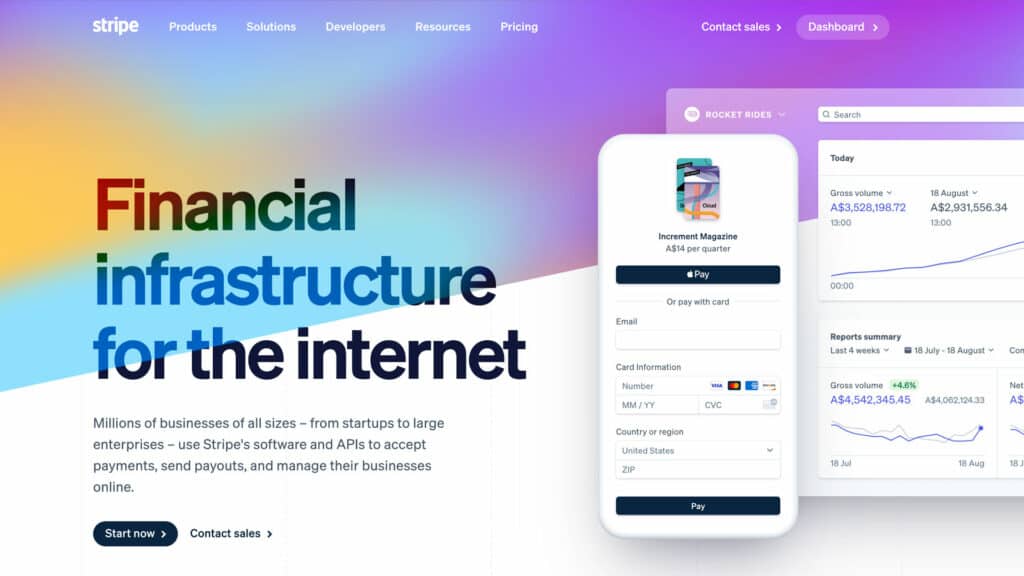
Stripe is the default choice for most Australian businesses, and for good reason. The dashboard is clean, the documentation is thorough, and it handles everything from one-off payments to subscriptions without extra plugins or workarounds.
Domestic card transactions cost 1.7% + $0.30, with no monthly or setup fees. International cards cost more at 3.5% + $0.30. Stripe also includes fraud detection (Stripe Radar), invoicing, and support for Apple Pay and Google Pay.
Where Stripe earns its spot is flexibility. Whether you’re running a membership site, taking donations, or selling services through your business website, Stripe can handle it.
2. PayPal
PayPal is the most recognised payment brand in Australia. That recognition matters because customers trust it. If someone hesitates about entering card details on a site they’ve never visited, seeing PayPal as an option can push them over the line.
The trade-off is cost. PayPal’s domestic transaction fee sits around 2.6% + $0.30, which is higher than most alternatives on this list. There are also occasional holds on funds that frustrate business owners.
PayPal works well as a secondary gateway alongside a cheaper primary option like Stripe or eWay. We’ve covered the best PayPal alternatives for Australian businesses in a separate guide if you’re weighing up your options.
3. Square
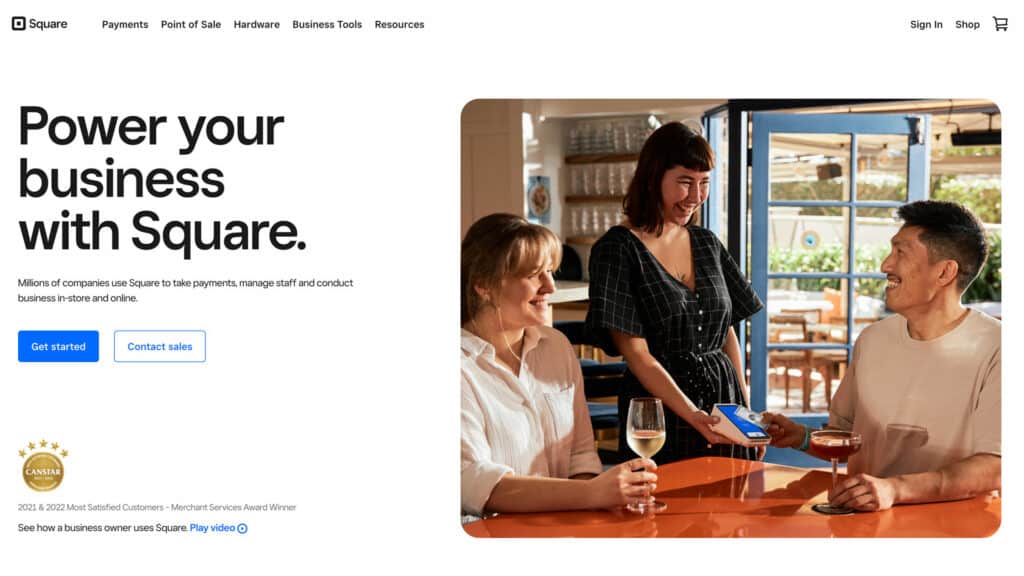
Square started as a point-of-sale system and expanded into online payments. If your business operates both in-person and online, Square’s ability to unify those two sides under one dashboard is its main selling point.
In-person transactions cost 1.6% per tap or insert. Online transactions cost 2.2%. Square also offers invoicing, inventory management, and customer relationship tools built in.
The limitation is that Square’s online payment features aren’t as mature as Stripe’s. It suits businesses where in-person sales are the primary revenue stream, with online payments as a secondary channel.
4. eWay
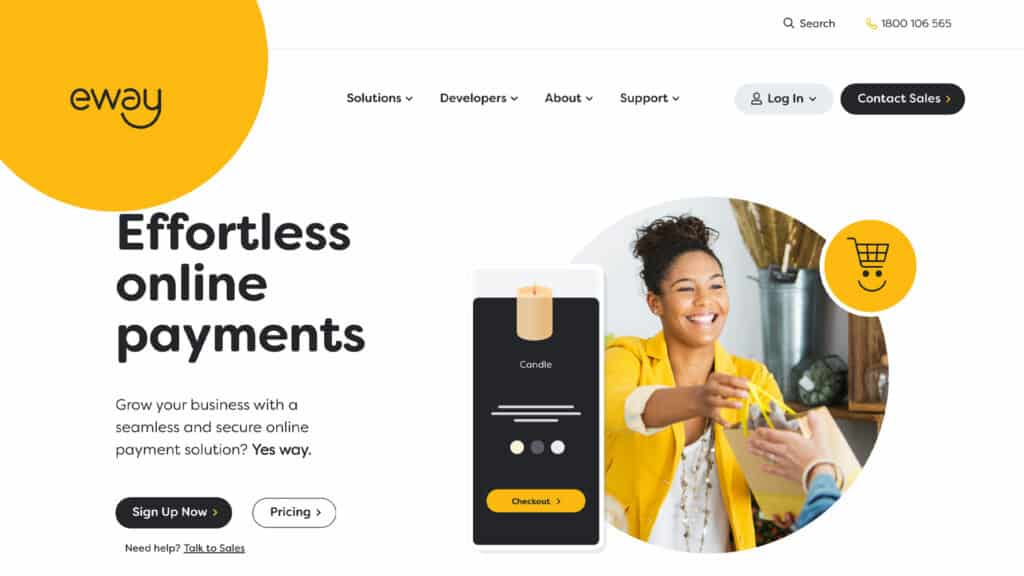
eWay is an Australian-built gateway that’s been around since 1998. It processes transactions for over 28,000 businesses in Australia and offers some of the lowest flat-rate fees on this list at around 1.5% + $0.25 per domestic transaction.
The platform includes fraud prevention tools, 24/7 Australian-based support, and fast settlement times. eWay integrates with most major website platforms through plugins and also offers a developer API for custom setups.
If you want a straightforward, low-cost gateway built specifically for the Australian market, eWay is hard to beat.
5. Tyro
Tyro is an Australian bank and payment provider that specialises in EFTPOS terminals for hospitality, retail, and health businesses. If your business takes most of its payments face-to-face, Tyro’s same-day settlement and integrated tipping features make it worth a look.
Tyro’s pricing is customised based on your transaction volume and business type. They don’t publish a flat rate, which means high-volume businesses can often negotiate rates that undercut the flat-rate providers on this list.
6. Zeller
Zeller launched in 2021 and has grown quickly by offering an all-in-one payments platform built for Australian businesses. Their EFTPOS terminal charges 1.4% per tap or insert transaction, which undercuts most competitors.
What sets Zeller apart is the Zeller Transaction Account. It gives you same-day access to your funds without waiting for bank transfers. They also offer invoicing, a debit card linked to your transaction account, and an online payment portal.
For businesses that want a single provider for terminal, online, and invoice payments, Zeller is a strong option.
7. Pin Payments

Pin Payments is an Australian gateway that lets you accept payments without a separate merchant account. That makes it one of the easiest gateways to set up, and it’s popular with startups and small businesses just getting started in Australia.
Domestic transactions cost 1.6% + $0.30. Pin Payments supports 23 currencies, so it also works for businesses selling to international customers. There are no monthly fees, no setup fees, and nonprofits get a discounted rate.
8. Airwallex
Airwallex is built for businesses that deal with international payments. If you’re paying overseas suppliers, receiving payments in multiple currencies, or expanding beyond Australia, Airwallex can save you serious money on foreign exchange fees.
Their gateway starts from 1.0% + $0.30 for domestic transactions, making it one of the cheapest options on this list. International transactions avoid the typical 3-4% currency conversion fees because Airwallex holds funds in local currencies.
Airwallex is more complex to set up than Stripe or Pin Payments, so it suits businesses with genuine international payment needs rather than a purely domestic operation.
9. GoCardless
GoCardless handles bank-to-bank direct debit payments, which makes it the best choice for businesses that run on subscriptions or recurring invoices. Instead of charging a card, GoCardless pulls funds directly from the customer’s bank account.
The cost is 1% + $0.30 per transaction, capped at $2. That cap means GoCardless gets proportionally cheaper as your average transaction size increases.
The limitation is that GoCardless only handles recurring or invoice-based payments. It’s not a card payment gateway, so you can’t use it for one-off website purchases. Many businesses pair GoCardless with Stripe or another card gateway to cover both scenarios.
10. Adyen
Adyen is an enterprise payment platform used by large businesses globally. It uses interchange++ pricing, which means you pay the actual card network fee plus a small Adyen markup. For high-volume businesses, this usually works out cheaper than flat-rate pricing.
Adyen supports over 250 payment methods and operates in 30+ countries. It’s overkill for most small businesses, but if you’re processing significant transaction volume, the savings from interchange++ pricing add up quickly.
How Payment Gateways Work
When a customer pays on your website, the payment gateway handles the transaction in a few steps:
- The customer enters their card details at checkout.
- Your website sends the transaction details to the payment gateway.
- The gateway encrypts the data and forwards it to the acquiring bank (your bank).
- The acquiring bank sends the request to the card network (Visa, Mastercard), which routes it to the customer’s bank.
- The customer’s bank approves or declines the transaction and sends a response back through the same chain.
- The gateway relays the result to your website and the customer sees a confirmation or error.
This entire process happens in a few seconds. The gateway’s main jobs are encryption (keeping card data safe), routing (getting the transaction to the right bank), and compliance with the Payment Card Industry Data Security Standard (PCI DSS).
Payment Gateway vs Payment Processor
These two terms get used interchangeably, but they do different things.
A payment gateway is the customer-facing technology. It’s the checkout form on your website that captures card details and sends them securely onward. A payment processor handles the actual movement of money between banks, communicating with the card networks (Visa, Mastercard) and the customer’s bank to authorise and settle the transaction.
In practice, most modern providers (Stripe, Square, PayPal) bundle both into one service. You don’t need to choose a separate gateway and processor unless you’re running a high-volume operation with specific technical requirements.
How to Choose the Right Payment Gateway
The right gateway depends on how your business actually operates. Here are the factors that matter most:
- Look at transaction fees relative to your average sale size. For purchases under $50, the fixed per-transaction charge matters more than the percentage.
- Check settlement speed. Tyro and Zeller settle same day. Others take up to 5 business days, which affects your cash flow.
- Match the gateway to your payment types. Do you need in-person terminals, online-only, recurring billing, or a mix?
- If you sell to international customers, check what currencies the gateway supports and what the conversion fees are.
- Consider whether the gateway integrates with your existing website platform. Most gateways offer plugins for WordPress and other major platforms.
- Australian-based support (eWay, Tyro, Zeller) means you’re not waiting for US business hours to resolve an issue.
If you’re also considering buy-now-pay-later options for your customers, our guide to Afterpay merchant fees in Australia breaks down what those cost compared to traditional gateways.
The Australian Government has announced plans to ban card payment surcharges. When this takes effect, businesses will absorb gateway transaction fees rather than passing them to customers, making low-fee gateways even more important for your bottom line.
If you’re unsure where to start, go with Stripe for online payments. It’s the most flexible option, and you can always add a second gateway later if your needs change. A well-built website with a smooth checkout process will make whatever gateway you choose work better.
Frequently Asked Questions
What is the best payment gateway in Australia?
Stripe is the best overall choice for most Australian businesses. It has competitive fees (1.7% + $0.30), no monthly charges, and works with most website platforms. For businesses that also take in-person payments, Square or Zeller offer combined online and terminal solutions.
What are the cheapest payment gateway fees in Australia?
eWay offers some of the lowest flat-rate fees at around 1.5% + $0.25 per domestic transaction. Airwallex starts from 1.0% + $0.30. GoCardless charges 1% + $0.30 capped at $2 per payment. For high-volume businesses, interchange++ pricing through Adyen can work out cheaper again.
What is the difference between a payment gateway and a payment processor?
A payment gateway captures and encrypts card details on your website. A payment processor moves the money between banks. Most modern providers like Stripe, PayPal, and Square combine both into one service, so you don’t need to choose separately for most setups.
Is PayPal still a good payment gateway?
PayPal’s brand recognition helps conversion rates because customers trust it. But its fees (around 2.6% + $0.30) are higher than most competitors. It works best as a secondary payment option alongside a cheaper primary gateway like Stripe or eWay.
What is replacing PayPal in Australia?
PayPal isn’t disappearing, but businesses are increasingly using Stripe, Square, and newer Australian options like Zeller as their primary gateway. These offer lower fees and faster settlement. PayPal still works well as an optional checkout method for customers who prefer it.
Do I need a merchant account for a payment gateway?
Not with most modern gateways. Stripe, PayPal, Square, Pin Payments, and Zeller all act as payment facilitators, meaning you can start accepting payments without setting up a separate merchant account with your bank.
Are payment gateways secure?
All reputable payment gateways are PCI DSS compliant, meaning they meet strict security standards for handling card data. They use encryption and tokenisation to protect sensitive information. You should never store raw card numbers on your own website.
Can I use multiple payment gateways on my website?
Yes. Many businesses use two gateways, for example Stripe for card payments and PayPal as an alternative. Offering multiple payment methods at checkout can improve conversion rates because customers can choose what they’re comfortable with.
What is the Australian surcharge ban?
The Australian Government has announced plans to ban card payment surcharges on most transactions. When this takes effect, businesses will need to absorb gateway transaction fees rather than passing them on to customers. This makes choosing a low-fee gateway more important than ever.
How long does it take to set up a payment gateway?
Most hosted gateways (Stripe, PayPal, Square) can be set up in under an hour. You create an account, verify your identity, and connect it to your website. More complex gateways like Adyen or Airwallex may take several days due to additional compliance checks.
Next Steps
Getting your payment gateway right is one piece of building a website that actually converts visitors into paying customers. The gateway handles the transaction, but everything leading up to it (your page layout, your calls to action, how fast your site loads) determines whether customers reach checkout in the first place.
If you need help building a business website that works, take a look at how much a website costs in Australia or get in touch for a free quote.